

A hepatitis B vaccine trial in Guinea-Bissau was shut down after the director of the World Health Organization and a chorus of bioethicists called it unethical.
Guinea-Bissau is a small West African country with one of the world’s highest rates of hepatitis B infection. Between 12 to 19% of people there carry the virus.
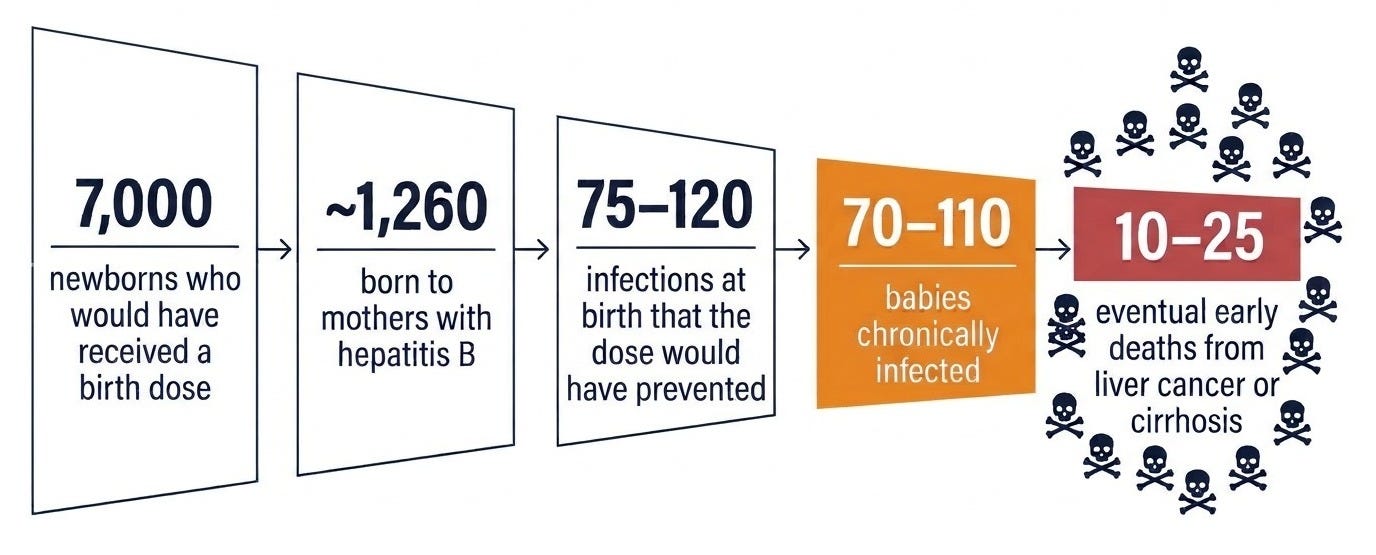
I asked Claude Fable 5.2 how many babies will get sick or die as a result. Its answer: 70–110 babies will get a chronic hepatitis B infection and 10–25 will die premature deaths. This was a conservative estimate.1
Here’s what bioethicists and global health professionals had to say about the trial:
Gavin Yamey, a professor of global health at Duke, told the BBC the planned trial “reeks of neocolonialism.”
Paul Offit called it “RFK Jr’s Tuskegee Experiment” (the trial was funded in part by a $1.6M CDC grant).
Arthur Caplan, a famous bioethicist, called it “manifestly on its face unethical,” and found it “highly unusual” that Bill Ackman’s Pershing Square Foundation was helping fund it.
Seema Shah, a bioethicist at Lurie Children’s Hospital, said they were “using the study and the infants in Guinea-Bissau, for their own ends.”
Tedros Adhanom Ghebreyesus, the WHO’s director-general, called the trial “unethical.”
Boghuma Titanji, an assistant professor of medicine at Emory, said the trial was “unethical” and will “seed medical mistrust.”
The Global Health Justice initiative at the University of Washington wrote that “using infants in Guinea-Bissau for politically-motivated medical experimentation is indefensible.”
Under this pressure, the government of Guinea-Bissau suspended the trial in January. An ethics committee in Guinea-Bissau had approved the trial, but the government that took power in a coup shortly afterward said it had never authorized it. When the researchers tried to return with a revised protocol in October, police raided their offices and seized the vaccines.
The bioethicists who were instrumental in getting the trial shut down had several objections:
The main objection was that the control babies would not get the vaccine at birth. Instead, they would get the normal schedule, with a first dose at six weeks, which is what every baby in the country gets today. Thankfully, now that the trial has been stopped, no new babies will get the dose at birth.
The organization that was going to run the trial, Bandim Health Project, was called “anti-vaccine.” That’s curious considering they have been running clinical trials on vaccines since 1978. According to Claude, Bandim Health Project has consistently argued that live vaccines such as measles, BCG and oral polio save more lives than expected, and they have pushed for wider and earlier use of them. Bandim argues that attenuated live vaccines are better than non-live vaccines because they cause positive non-specific immune-boosting effects (trained immunity), while non-live ones do not. This view is very contested within immunology, but it is a legitimate scientific hypothesis that can be tested, and that was what Bandim Health Project was seeking to do. Over the years Bandim Health Project has run at least 10 RCTs on vaccines including more than 74,000 children. One study they ran in 2000 on the non-specific effects of vaccination has been the subject of controversy because it didn’t replicate.
The trial was said to be politically-motivated and designed to show harmful effects from vaccines. The trial was focused on whether the birth dose has additional “non-specific” effects on overall health. The plan was to follow the children for five years, comparing overall mortality and hospitalizations, with secondary outcomes of atopic dermatitis and neurodevelopment. They were also going to track hospitalization from other diseases after vaccination. Schaltz-Buchholzer, a researcher associated with the trial, says that a working hypothesis they wanted to test is whether the non-live Hep-B vaccine might attenuate the benefit of the live vaccines given at birth (BCG + oral polio).
Others took issue with the fact that the trial was single-blinded, not double-blinded. This is a very legitimate thing to complain about! However, rather than calling for a reform of the trial design, the bioethicists uniformly denounced the trial as “unethical” and pushed for it to be canceled completely.
The trial was the only way a mother in Guinea-Bissau could give her baby a birth dose at all.2 This was called “coercive consent.” It’s interesting that a voluntary offer that leaves you better off by accepting than refusing is considered coercive.
According to the latest version of the Declaration of Helsinki, international research should be reviewed in both the sponsoring country and the host country. However, the Danish government does not have procedures in place to review trials conducted outside its borders. Because of this, the trial technically violated the Declaration of Helsinki.
After the trial was shut down, Bandim Health Project went back to the government of Guinea-Bissau with a new design containing a placebo where “parents, follow-up teams and the trial statistician will be blinded to allocation.” Additionally, mothers were to be tested, and every baby of a mother who tested positive would get the birth dose. The University of Southern Denmark’s Research Ethics Committee approved the redesigned trial. However, this was not enough for the government to re-authorize the trial.
Bioethicists won, babies will die, and now anti-vaxxers will get a talking point.
The estimate assumes 7,000–9,000 mothers would have been enrolled before the roll-out of Guinea-Bissau's national birth dose begins in 2028. If the government’s roll-out were delayed, which has already happened once, the trial was going to continue enrolling more mothers, potentially up to 25,000 total. Also, this estimate was for the original protocol that the bioethicists complained about. Under the revised protocol, every baby whose mother tested positive for hepatitis B would have received a birth dose, resulting in the trial saving even more lives. Also, mothers would have learned their hepatitis B status, which they probably would not have learned otherwise.
A dose within 24 hours of birth works as post-exposure protection, and prevents 70–95% of mother-to-child transmission. Currently Guinea-Bissau waits until six weeks to give the vaccine, which is too late to stop an infection acquired from the mother.