

Note: I originally wrote this in 2015 and it was previously published on my website. I think it’s one of the best things I wrote during my grad school days (2010-2016) so I wanted to share it here.
“For a successful technology, reality must take precedence over public relations, for nature cannot be fooled.” – Richard P. Feynman
“…where dreams alone are blueprints, nightmares result.” -Theodore Dalrymple
“folly: noun ˈfälē 2. A costly ornamental building with no practical purpose, especially a tower or mock-Gothic ruin built in a large garden or park.” – Oxford English dictionary
Nikola Tesla’s life is a story of meteoric rise to international prestige and fame followed by an equally dramatic retreat into public shame, depression, and loneliness. The turning point seems to have occurred during Tesla’s time in Colorado Springs between 1899 and 1900. It was during this period that Tesla failed to properly confront reality and got lost in his own fantasy world.
Denial of failures led to further failure and further denial – a downward spiral which eventually led Tesla to a mental breakdown. This essay explores where Tesla went wrong and how a scientific genius descended into madness.
What distinguished Tesla from other great scientific minds of his age was his ability to dream. Tesla had an uncanny ability to imagine how the human condition could be made better by technology. Tesla’s inventions — the brushless AC motor, fluorescent lamps, the radio controlled boat — all began as a clear concept in his own mind of how they would benefit humanity.
Tesla explained his invention process as taking place completely within the visualization apparatus of his own mind. Once Tesla had the concept of an invention fully visualized he then undertook the hard work of bringing it into reality, by running the necessary calculations and building and testing prototypes. This approach contrasted from that of many other scientists and engineers, who were more “tied to the bench” and more myopic in their thinking. Tesla’s imagination was, quite simply, unbounded.
Up until 1899, this style of working worked well for Tesla. His greatest invention, the brushless AC motor, began with a realization that such a motor would be highly superior to the motors of his day. He also dreamed of an elegant AC system, free of AC-DC and DC-AC converters, to power his motor. Despite an objection from his teacher that a brushless motor would be impossible, Tesla refused to relinquish his dream and carried it around for years before eventually stumbling upon a way to achieve it. (According to Tesla, the design for the brushless AC motor sprang into his head one day in February 1882 while he was walking in a city park in Budapest and reciting a stanza from Goethe's Faust.)
Tesla’s psychological disposition towards dreaming is an important part of this story, but it also important to also consider the society which Tesla interacted with during this time. In the economic sphere, electrification had created an investment and startup bubble of even greater frenzy than the heyday of the .com bubble of the 1990s. Billion dollar industries arose out of thin air and the economy was lifted into a “long wave” of enhanced growth that would last for decades.
The societal change brought about by electrification was literally one from dark to light. Electrification buoyed up a zeitgeist of technological optimism that can scarcely be comprehended today, since everyone alive today was born with electricity. The sheer magnitude of technological change during that time period boggles the mind. Tesla thrived on this technological optimism and his ideas were eagerly picked up by the leading newspapers of the day. He was close friends with several journalists and actively took part in the promotion of his ideas in the popular press, hoping that investors would seek him out as a result. In the sensational coverage Tesla received, fact and fiction were blurred and Tesla was often lauded for having demonstrated inventions he had not yet actually built. The public prestige Tesla accrued made him even more sure that even his most grandiose dreams could be realized.
In 1899, Tesla’s big dream was wireless power. Tesla had already demonstrated wireless transmission of power over small distances in his lab. Now, Tesla imagined constructing special stations which would send electricity and communications to the entire globe, an idea he called the World Wireless System. His ideas were lauded by the press, for instance, for example:
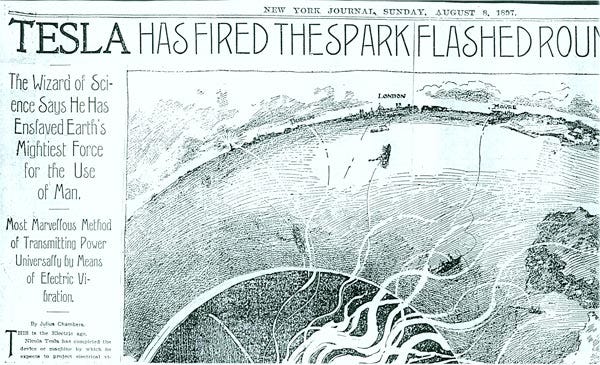
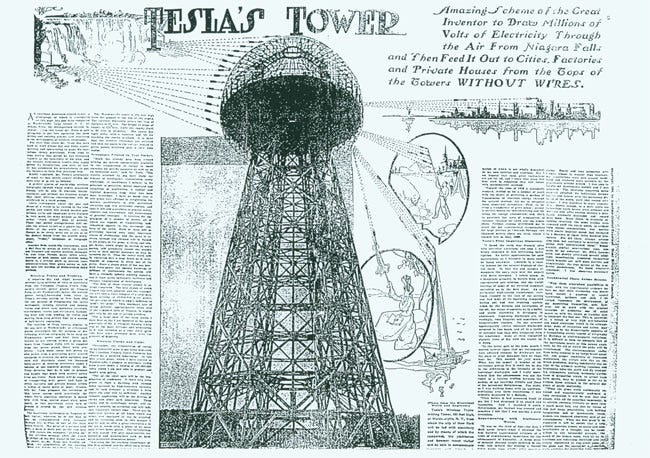
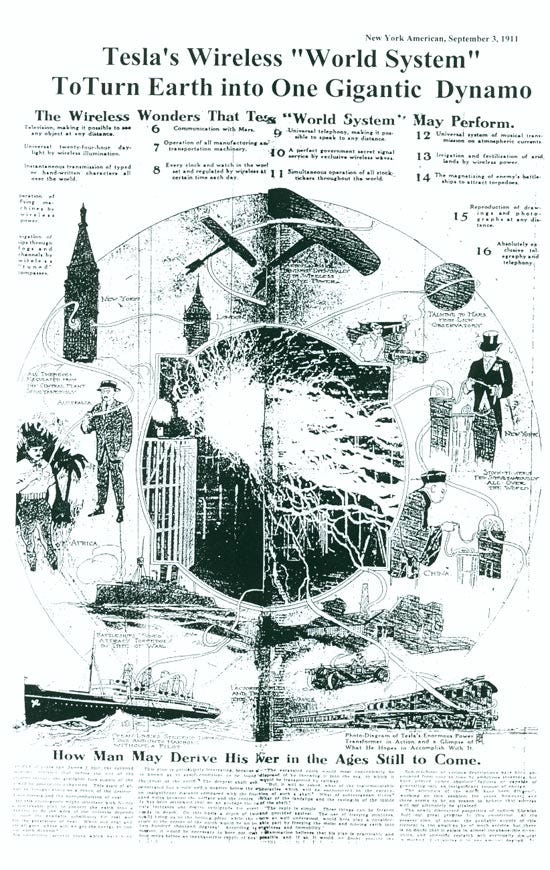
These stories were tabloid stories which took Tesla’s proclamations and ran with them, part of the sensational yellow journalism of that era [Carlson, 408].
The second image above (“Tesla’s Tower”) captures the now popular conception of Tesla’s system of wireless electricity – a large tower ‘beams’ electrical energy to receivers – for example, a woman with an umbrella, or a person on a ship.
The first objection which any person who has taken elementary physics may raise to this idea is the fact that the energy of electromagnetic waves per unit area outputted by an antenna decreases as the inverse square of the distance from it. In other words, the energy contained in electromagnetic waves spreads out and dissipates very rapidly in free space.
To make this more concrete, consider a cell phone, which is constantly sending out electromagnetic waves in all directions. The amount of electromagnetic energy passing through your hand when it is one meter from your phone is 10,000 times smaller than when it is one cm from the phone. When your hand is one km from the phone, the amount of energy passing through it is 10,000,000,000 times smaller.
Tesla was completely aware of the limitations imposed by the inverse square law. To overcome them, Tesla entertained three possible workarounds in his imagination:
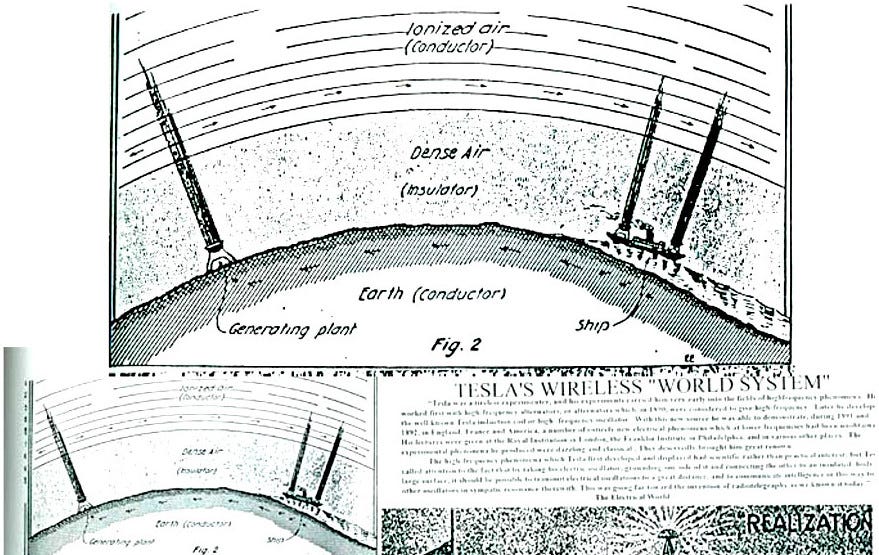
The first workaround was to utilize resonance. Like sound waves, electromagnetic waves can resonate with cavities or material bodies, producing standing waves. When a standing wave is formed, waves traveling in opposite directions interfere, adding constructively at some points and destructively in others. The points of maximal constructive interference are called nodes. Tesla imagined that electrical waves must be able to resonate with the Earth, both inside the Earth and in the atmosphere, which can be thought of as a ‘cavity’ between the Earth and outer space. He imagined that receiving stations could be placed at the nodes of such resonances, where the constructive interference would greatly enhance the amplitude of the waves. These local stations would then presumably transmit signals via a local tower to receivers like the umbrella or via conventional wires.
The next workaround Tesla envisioned was to “flip radio on its head” [Carlson, pg 210]. During Tesla’s day, waves of electrical current and waves in the electromagnetic field were often thought to be two aspects of an underlying phenomenom – “electrical energy”. Many early electrical experimenters thought that electromagnetic waves were waves of current traveling through the atmosphere. Others thought waves of current were electromagnetic waves, but confined to wires. In fact, the two are physically distinct phenomena, but intimately coupled through Maxwell’s equations.
In the late 1800s, the transmission of a radio signal from a source to a receiver was often thought of as an electrical circuit. Electrical energy traveled through the air from source to receiver, and then returned directly via currents through the Earth. This way of thinking about transmitting electrical signals was intuitive and meshed with the way people thought about telegraphy. (Hence the name “wireless telegraphy”.) This way of thinking is not at all rigorous, however, since with any transmitter the vast majority of electromagnetic energy is lost into outer space and only a small amount is picked up by the receiver. We know now that having a ‘complete circuit’ is also not necessary with radio as it is with a telegraph. However, using this way of thinking, Tesla imagined flipping conventional radio on its head – the signal would be transmitted through the Earth, and the electrical energy would return via current in the air. Based on his experiments with Geissler tubes, Tesla found that thinner air was more conducive to certain forms of high frequency ionization. Tesla therefore proposed using high altitude balloons to reach into the thinner atmosphere (contrary to popular opinion, Tesla did not know about the ionosphere). Later he switched from balloons to towers.
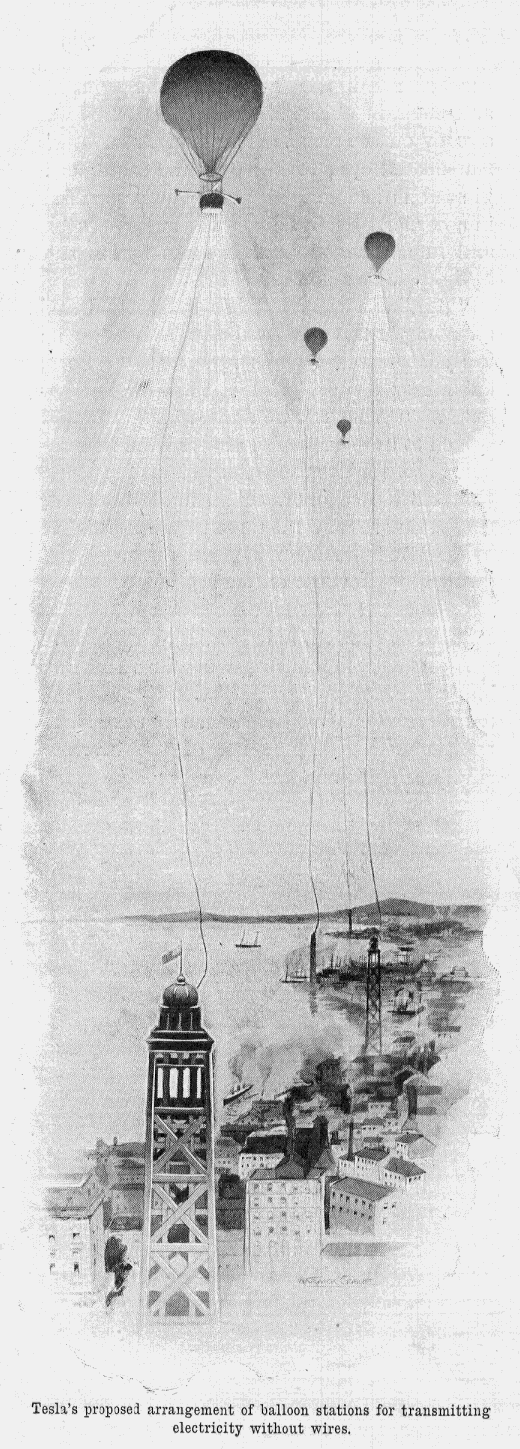
The third workaround which Tesla had was his idea to produce longitudinal electromagnetic waves, which he called “electromagnetic thrusts” having a “non-Hertzian” character. Tesla believed that just like sound waves, electromagnetic waves should come in two varieties – longitudinal and transverse. Longitudinal waves oscillate along the direction of motion of the wave, while transverse waves oscillate perpendicular to it. In the air only longitudinal sound waves can exist, but in solids both longitudinal and transverse sound waves exist. A simple way of illustrating the difference between these two types of waves is to use a slinky:

Around 1900 there were in Britain a small circle of “Maxwellians” who were undertaking the mathematical analysis necessary to connect Maxwell’s equations to the experimental findings of Hertz regarding electromagnetic waves. These physicists included Oliver Lodge, Oliver Heaviside, and George F. FitzGerald. Using Maxwell’s equations they proved, among other things, that all electromagnetic waves are transverse and that light is an electromagnetic wave. Although Tesla kept abreast of the work of the Maxwellians and was very adept at mathematics, he had little patience for theoretical analysis of Maxwell’s equations. Tesla saw the work of the Maxwellians as an ‘ivory tower’ pursuit and not very practical. Tesla made it very clear he thought that the Maxwellian’s central results were wrong, and he performed experiments with Rumkoff coils which he thought indicated that “non-Hertzian” “electromagnetic thrusts” existed [Carlson, pg 125-127].
Despite the scientific consensus today that all electromagnetic waves are transverse, some people still cling to Tesla’s notion that other forms of “non-Hertzian” electromagnetic waves exist. There are many reasons people can be confused about the non-existence of longitudinal electromagnetic waves. It is possible to produce solutions to Maxwell’s equations that have longitudinal waves, but only if one allows for the total amount of electrical charge in a system to fluctuate – that is, to not be conserved. The law of conservation of charge is one of the core conservation laws of physics (along with the conservation of energy) and has never been shown to be violated. If conservation of charge could be violated, longitudinal electromagnetic waves would be possible — a stationary point charge that oscillates in magnitude would create a longitudinal electrical wave.
Another reason for confusion is that in physics and engineering many approximations are usually invoked, which sometimes contain longitudinal waves. For instance, when an AC current is applied to a capacitor, students are taught a simplified picture of a perfectly uniform electric field between the plates changing directions, while the “edge fields”, the finite speed of light, and magnetic fields are neglected. This is a reasonable approximation since it can be shown that the neglected effects are small when the plates are close and the frequencies involved are low, which is usually the case. However, if one takes this approximate picture and then imagines that the spacing between the capacitor plates is very large and then considers the finite speed of light, one can easily be convinced into thinking that longitudinal waves would be produced. It is even possible to write down math with certain approximations that contains such waves.1
Returning to Tesla’s story, with his three ideas (resonance, “flipping radio”, and longitudinal waves), Tesla imagined the following – a tower could be constructed, which, when connected to a large Telsa coil would pump waves of electrical current through the Earth. At the right resonance frequency, standing waves would be set up, which would allow for receiving stations to harvest the electrical energy at great distances from the station.
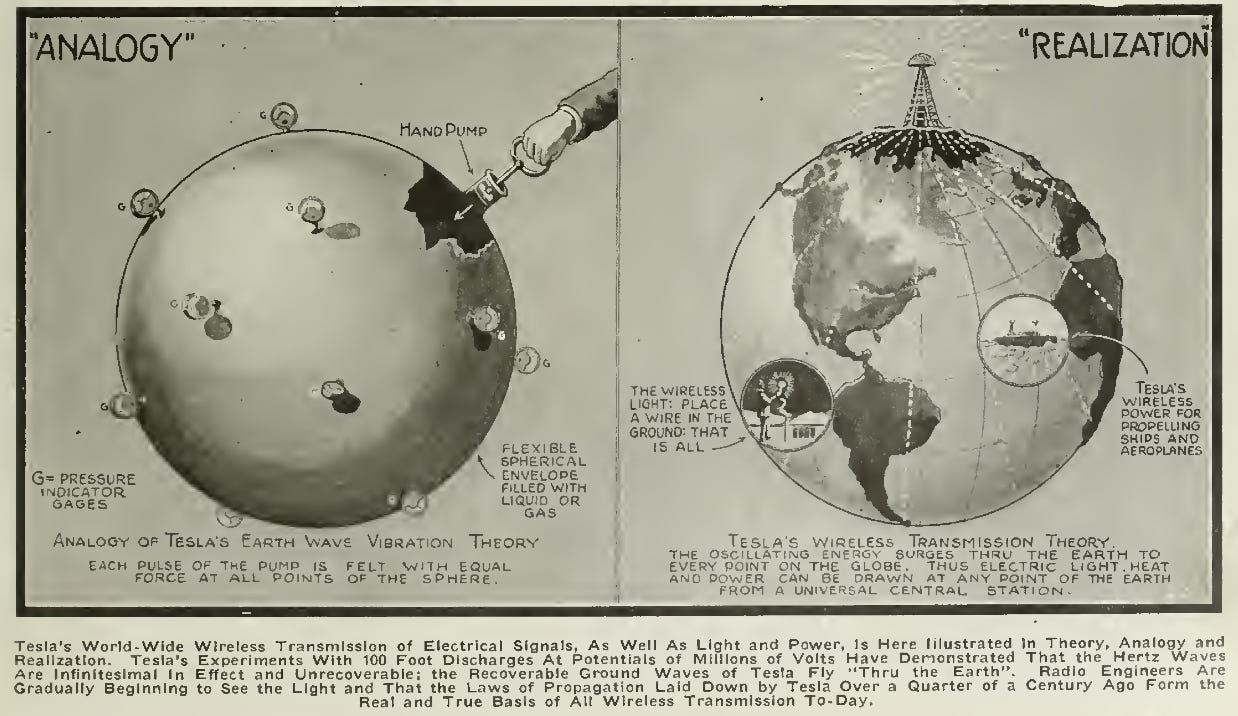
Besides being mistaken about longitudinal electrical waves, Tesla committed another grave error here – he assumed that electrical waves could travel through the Earth without dissipating. Later in his life Tesla imagined the Earth as filled with an incompressible fluid through which electrical waves could travel freely. In actuality, electromagnetic or current waves traveling through the Earth have losses of energy due to absorption which are quite large.2 This simple fact is why you can’t listen to the radio while driving through a tunnel.
Buoyed by what he perceived as success in laboratory experiments, Tesla traveled to Colorado Springs in 1899 to test his ideas on a larger scale. The result was, in brief, a classic case of someone running amok with confirmation bias. When Tesla achieved a desired result, such as lighting a bulb at a distance of 60 feet from his tower, he interpreted it as a success, while ignoring the fact that he was drawing ridiculously large amounts of power from the local power grid. Because the amount of power his tower drew was so large, Tesla was only permitted to run his tower during the night.
There is much confusion about what Tesla actually demonstrated in Colorado Springs and much has been written on the subject. While Tesla’s Colorado Spring Notes are copious, they are short on precision and detail. For instance, while Tesla is known for famous experiments where he lit bulbs remotely using his Colorado Springs tower by placing wires into the ground, he only noted the distances involved in two cases (60 and 62 feet from the tower) [Carlson, 240]. In his writings about his work in Colorado Springs, Tesla often emphasized that he had achieved wireless transmission of power, but did not specify exactly how far it had been transmitted. The claim of biographer John O’Neill that Tesla lit 200 lamps at a distance of twenty-six miles from Colorado Springs has never been substantiated [Carlson, 242]. Tesla did report receiving signals at distances in excess of one mile, but signals are very different than useful electrical energy. After his assistant Lowenstein quit, there are no eyewitnesses of Tesla’s work in Colorado Springs. Even when Lowenstein was there, he stayed in the control room and did not see what happened on the receiving end. Tesla’s work at Colorado Springs was very secretive, which stands in contrast to Marconi, who regularly performed public demonstrations.
“At Colorado Springs, Tesla appears to have sought only evidence to confirm his hypotheses and not look for anything that might disconfirm his theories.” — W. Bernard Carlson
Tesla’s work in Colorado Springs is characterized by confirmation bias, a problem that continues to plague scientists today. When horses were seen to be disturbed in a nearby pasture while his tower was running, Tesla assumed it was because the ground currents induced by his tower were being picked up by their iron horseshoes [Carlson, pg 289]. Another example comes from when Tesla made observations of the electrical potential of the Earth during a powerful lightning storm. As the lightning storm approached his tower and then passed into the distance he observed patterns in the electrical potential that were repeating with a 30-minute interval. He interpreted these patterns as being due to ‘stationary waves’ caused by the lightning which traveled through the Earth, reflected off the crust on the other side of the Earth, and then returned [Carlson, pg 270].
This is not, however, how science works. In order to prove a scientific hypothesis one must not only present data that supports it, but also rule out other possible explanations for the data. This can only be done through careful focused experimentation, repetition, and the elimination of sources of error.
As a consequence of not performing careful tests and not having eyewitnesses, Tesla was hard pressed to convince investors of the value of his proposed system. He tried to convince numerous New York investors, including John Jacob Astor and his close ally George Westinghouse, but came back empty handed. He took to writing sensational newspaper stories to garner support from the public.
The man who came to Tesla’s aid was the great industrialist J.P. Morgan. In order to get J.P. Morgan to invest in Wardenclyffe, Tesla sold Wardenclyffe as a project in radio, promising that he would send signals across the Atlantic in 6-8 months time. At the time, the furthest his rival Marconi had sent signals was 67 miles. Investors like Morgan were reluctant, since Marconi held many strong patents in wireless, but Morgan likely believed that Tesla’s technology might be different enough to circumvent those patents. After much haggling and exchanging of letters, Morgan agreed to loan him $150,000 to build the Wardenclyffe tower. Ironically, despite Morgan being the only investor willing to give Tesla a loan, and Tesla referring to him as “the Great Man”, Morgan is usually vilified as a stingy greedy banker in many present day accounts of this story.
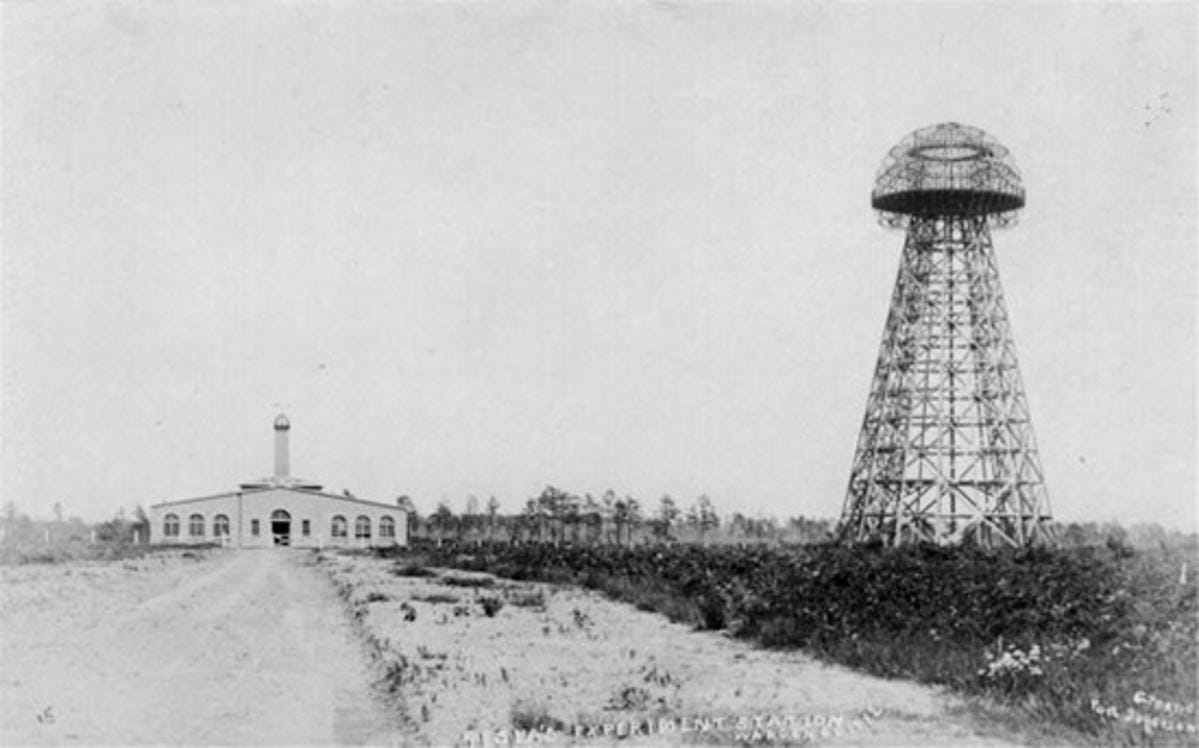
In 1901, a year after securing funds from Morgan, Tesla was living his dream. The Wardenclyffe tower was under construction, he had the financial backing of “the Great Man”, and he was living “like a millionaire” in the Astoria hotel [Carlson, pg 330]. The great Wardenclyffe tower rose majestically above the Earth, its signature dome pointing to the heavens. An expansive laboratory complex stood ready to be filled with generators and equipment. Below Wardenclyffe, a series of carefully constructed tunnels filled with metal pipes were designed to “grip the Earth” and shake it, sending current waves traveling across the planet.
All of these illusions of success would be ephemeral however. On December 12th, 1901, Marconi succeeded in transmitting a signal across the Atlantic. With his patents in hand, Marconi captured the limelight and became forever known as the inventor of radio, stealing credit from his predecessors and from Tesla. To Tesla’s dismay, Morgan refused to invest more money into Wardenclyffe.
Morgan’s reason for not continuing to invest in Tesla is clear – he had already spent $150,000 and Tesla had failed to deliver on his promise of transmitting across the Atlantic and had now been beaten by Marconi. Later, Tesla would give his own explanation why “the Great Man” refused to invest. At that time the wireless field was in the midst of a speculative bubble and in the words of Tesla, Morgan “would not touch it with a 20-foot pole”. Indeed, the wireless field in 1901 was rampant with investor mania, get-rich-quick schemes and hucksters who simply took investor’s money and ran [Carlson, pg 348].
The idea that Morgan refused to supply additional funding because “free energy” wouldn’t be profitable (as suggested at the end of the film The Secret of Nikola Tesla) doesn’t make sense – Tesla had sold the project to Morgan as a wireless communications tower, not as a means of producing and transmitting energy.
For the next few years, Tesla struggled to piece together money to finish the Wardenclyffe project. The tower and underground tunnels were built, but trial runs of the facility yielded no meaningful results, other than scaring the neighbors with flashes of electrical streamers. Tesla’s estimated costs for the completion of the project ballooned from $1 million to $2 million as he increased the number of steam turbine generators he thought necessary for the system to work. With no meaningful results to show, investors turned Tesla down, preferring to invest in technologies that had been proven, such as radio. Tesla fell into a state of depression.
The story of Tesla’s decline is sad, but it needs to be taken as it is. People often do not want to recognize their failures and so was Tesla — to the end of his life he insisted his genius was misunderstood. People are also reluctant to recognize the failures of those they admire or idolize. That is why it is easy to buy into Tesla’s excuse that if only investors had understood Tesla’s genius, then Wardenclyffe would have worked.
Excuses are easy to invent – if only he had more horsepower, then it would have worked. If only the tunnels had been deeper, the tower higher, then it would have worked. People find the prospect of wireless electricity enticing. Since wireless electricity does exist on small scales, why should it not be possible on large scales as well? The problem is that Tesla neglected to carefully study how things scale – based on his ability to light a bulb at a distance of 60 feet, he erroneously calculated that using the same method he should easily be able to light one at a distance of many miles. Today well established physics tells us you can’t scale such systems the way Tesla thought. Still, many persist in insisting Tesla must have been right. Some people find it easier to believe that Tesla had secret knowledge which turns hundreds of years of careful scientific research on its head than to accept that Tesla might have been wrong.
The fact is that while scientific knowledge as a whole progresses, some do not progress with it. When the Maxwellians used Maxwell’s equations to show that electromagnetic waves were always transverse, some such as Tesla refused to accept it. Similarly in the 1800s many of the scientific elite were slow to accept the atomic hypothesis, despite growing evidence for it (most notably, Ernst Mach, who refused to accept the idea even after Einstein used atoms to explain Brownian motion in 1905). Similarly, many of the scientific elite of the early 1900s (including Einstein) refused to accept the weirdness of quantum mechanics.
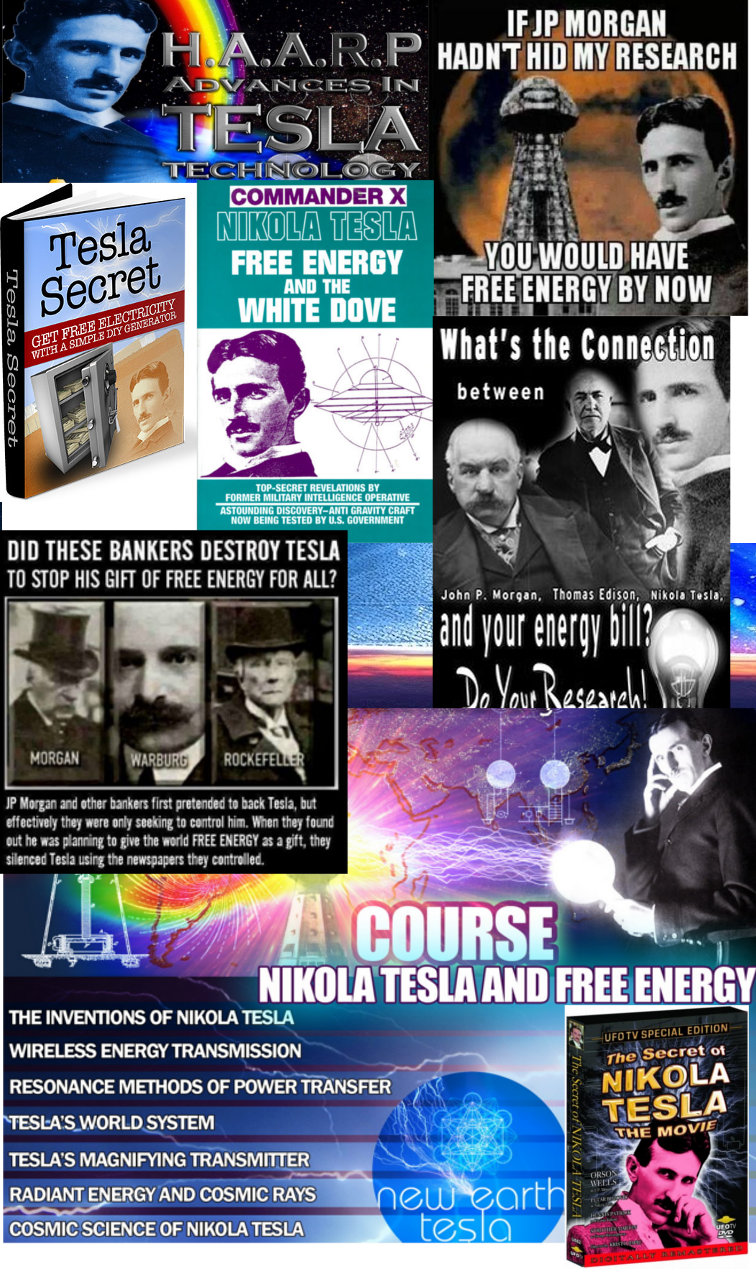
The fact is, like many of the electrical engineers of his day, Tesla harbored ideas about electromagnetism that were, if not fully wrong, at least partially so – radio transmission doesn’t work like a telegraph circuit, electromagnetic waves are not like sound waves, and it isn’t possible to create current waves that pass through the earth for thousands of miles unimpeded. Yet somehow, some of his ideas persist in people’s imagination today — we feel the pain of Tesla’s failure, and we seem to hear his voice traveling through the ether, asking us to give him one more chance. The fact that people are still influenced by Tesla’s ideas today is testimony to his power to dream – and his power to use his friends in the press to promote his dreams to the public [Carlson, pg 408]. Today Tesla “free energy” websites and books can be found all over the internet. There was even a team of Russians raising money to try to rebuild Tesla’s tower, using the same misguided ideas such as standing waves in the Earth’s interior, etc.
Whenever “free energy” schemes fail we hear the same pleas — it would have worked if only we had more funding, it would have worked if not for a corporate conspiracy, it would have worked if only the scientific establishment had understood our genius.
The minds of men are easily led into believing such pleas, but nature cannot be fooled.
Primary Reference
W. Bernard Carlson. Tesla: Inventor of the Electrical Age, 2014.
These problems appear to all arise when one considers the effects of a finite speed of light together with approximate equations derived precisely under the assumption that the speed of light is infinitely fast relative to the speed of charges in the system (ie, the equations of the quasi-static approximation.) Another source of confusion often discussed in Tesla circles is the fact that in the full solution of the dipole radiator, some of the near-field terms considered in isolation have a sort-of longitudinal-like character. In the full solution, however, the longitudinal character disappears.
To get into more technical detail here, the amount of loss for EM waves traveling through the Earth depends on the type of material involved, be it salt water, wet soil, dry soil, or rock. More conductive media (such as wet soil, salt water) are harder to transmit EM waves through due to screening – all frequencies below the plasma frequency are heavily absorbed / screened. On the other hand, dense non-conductive media like rock can be hard to transmit through due to absorption. Low frequency waves called ground waves allow kHz signals to propagate for perhaps hundreds of miles from a typical radio transmission tower. However, what is written on Wikipedia and elsewhere about ground waves is often misleading – ground waves travel above the ground rather than in the ground. However it is true that extremely low frequency waves (1 – 3000 Hz) can travel great distances even through rock or salt water. Such extremely low frequency (ELF) waves are used to communicate with subs. They can also penetrate tens of kilometers into the Earth, although they scatter and refract around boundaries between different rock layers in highly unpredictable ways. Creating such low frequency waves is difficult and requires very long antennas. Tesla discussed low frequency resonances of the Earth, but the Wardenclyffe tower and Colorado Springs Tesla coil operated at much higher frequencies.