

(first published on Substack Notes, 6/27/2026)
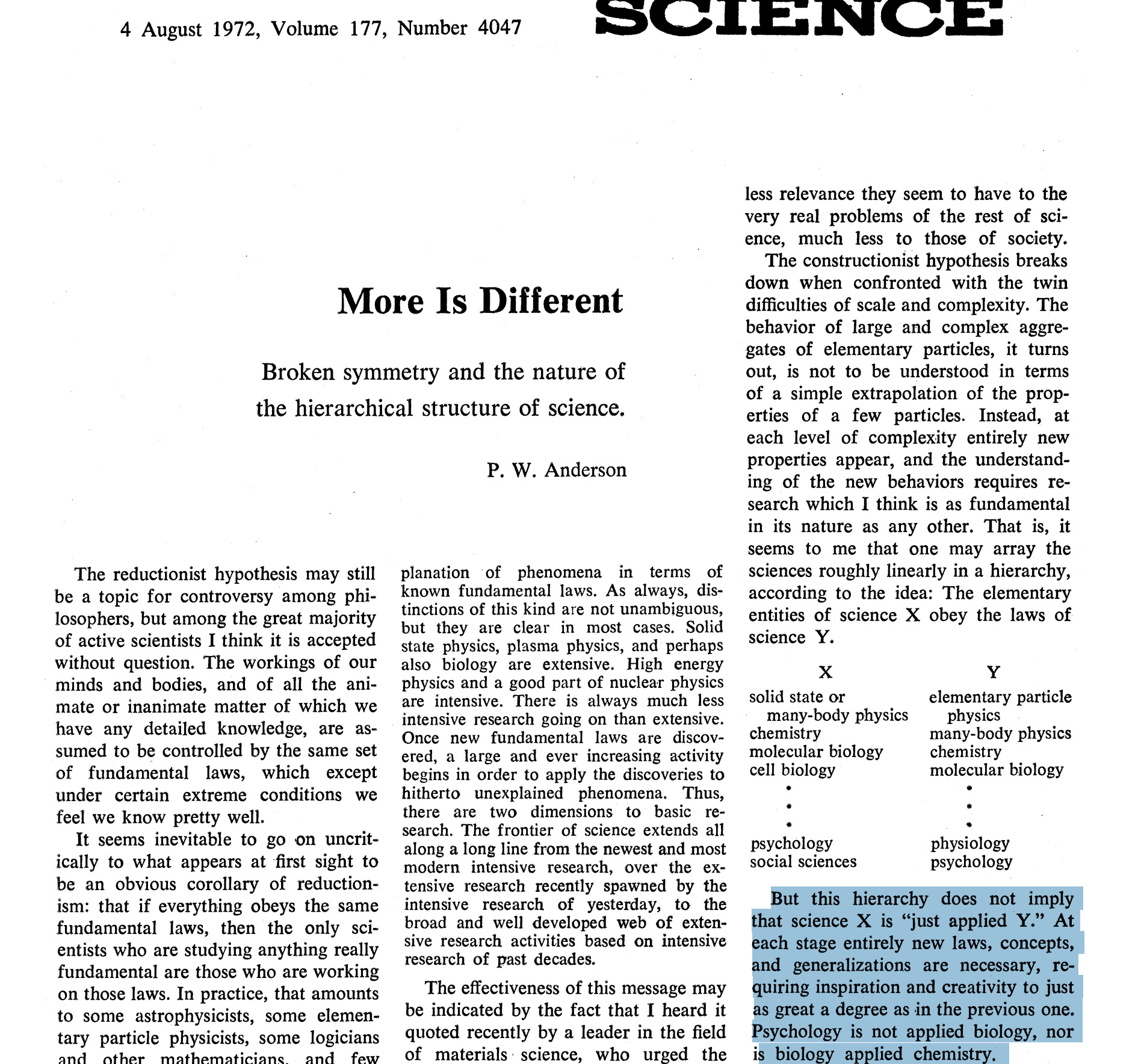
Sometimes I think about changing the name of my Substack (“More is Different”), but then I look at the many ridiculously-named blogs that are wildly successful — Numb at the Lodge, Ribbonfarm, Astral Codex Ten, Don’t Worry About the Vase, Slime Mold Time Mold.
For those who aren’t aware, my blog is named after a 1972 article by condensed matter physicist and Nobel Laureate Paul Anderson. The article is about the phenomena of emergence. We all know that everything obeys the laws of physics. Yet, chemistry is not just applied physics, it has its own emergent concepts and laws. Similarly, biology is not just applied chemistry, psychology is not just applied biology, and sociology is not just applied psychology.
During my physics PhD research I was enthralled by emergent phenomena. I started a WordPress blog called “More is Different” around 2012, and the domain moreisdifferent.com was gifted to me in 2015.
I did my PhD in a lab that investigated various properties of liquid water and ice using molecular dynamics simulation and quantum simulation. One of the papers I wrote that I am most proud of dives into exquisite detail describing how water absorbs microwaves. You can’t understand how water absorbs microwaves by looking at just one or even just a dozen water molecules in isolation. The process of microwave absorption can only be understood in the context of hundreds of molecules undergoing a collective rearrangement within a broader dielectric media created by the water itself.
In a 2015 paper in Nature Communications I showed for the first time that liquid water contains short-lived phonons. Phonons are an emergent phenomena - a type of “quasiparticle” that emerges from vibrations in a crystal lattice (in the case of liquid water, the “crystal lattice” is actually a very short-lived network of water molecules connected by hydrogen bonds).
Water exhibits many surprising emergent properties - for instance if you apply pressure to ice it will melt, a very strange phenomena. At different temperatures and pressures water exhibits 14 crystalline solid phases and two amorphous solid phases.
Back in my PhD days I was very interested in topics like cellular automata, statistical mechanics, percolation theory, and chaos theory. A unifying feature of these topics is the emergence of complexity out of simplicity. It’s wonderful discovering how unexpected phenomena can emerge from simple rules. Equally enthralling is observing a very complex phenomena and then figuring out how a few simple rules can generate it.
I was attracted to these topics because I found them beautiful. In fact, I’ve always been a bit of a mystic - I believe in objective beauty, and I believe that it is closely bound up with emergence. Some of the most objectively beautiful phenomena live in a “critical” space between perfectly predictable order and completely random disorder. One might say that the emergent is the beautiful. Snowflakes, trees, clouds, galaxies.
I sometimes dream of being able to retreat somewhere to study such topics again, but alas, more temporal considerations have reared their head. Now I am focused on reducing existential risk from AI as well as dealing with personal health concerns and other practical matters.
Maybe after existential risk has been reduced and aging has been cured and I am fully healthy and secure in my life I’ll feel comfortable returning to dive deep into those topics that once enthralled me and filled me with aw and wonder.