

You may have come across social media posts on how to optimize your sleep that contain a long list of interventions:
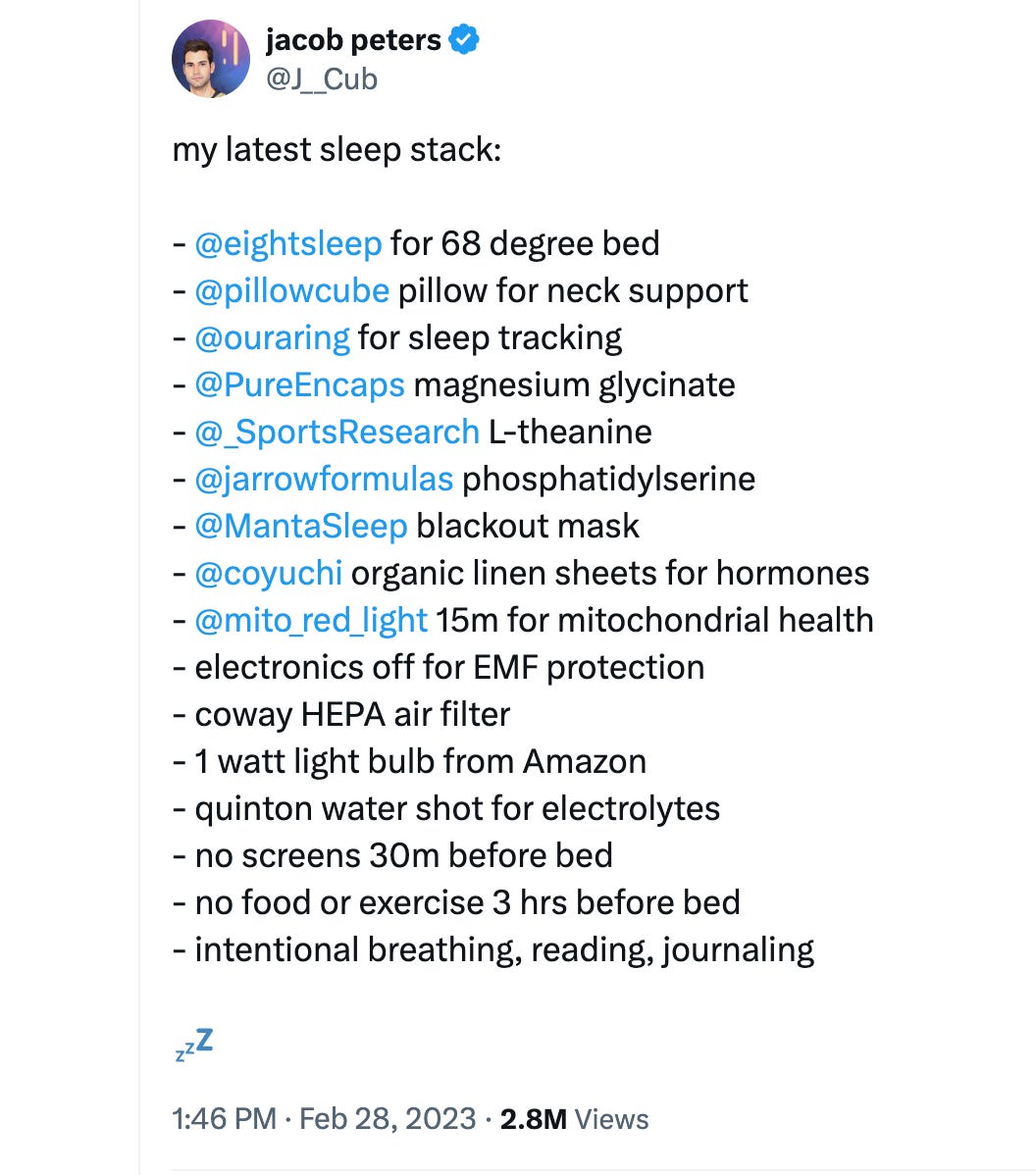
In this post I’ll explain why these “sleep stacks” and “sleep optimization tips” can be counterproductive for some people.
Previously I wrote about sleep medications on my Medium, drawing on my experiences during 2022-2023 when I decided to experiment with them. I also put that article on the r/insomnia Reddit, where its gotten 287,000 views. The article’s popularity on Reddit led to a journalist interviewing me for four hours as part of their research for an article about how to fix insomnia without sleep medications.
It seems many people are very interested in sleeping better! I hope this is of interest even though it deviates from the sort of things I normally write about on my Substack.
Five causes of insomnia
I personally have found it very useful to distinguish five distinct causes of insomnia. Usually one of these causes is dominant, but they can overlap. Insomnia solutions must be tailored to addressing whichever causes one is dealing with:
Bad sleep hygiene - this generally results in a mild form of insomnia. When sleep hygiene is improved, this insomnia goes away.
A sleep disorder - the major sleep disorders are sleep apnea, restless legs syndrome (RLS), and periodic limb movement disorder (“hidden RLS”). The insomnia can be mild to severe. When the disorder is treated, the insomnia goes away.
Depression - in some people, major depressive disorder can cause insomnia. A common type of insomnia associated with depression is early morning awakening - waking up too early and not being able to fall back asleep. When the depression is treated, the insomnia goes away.
Unresolved stressors / emotional issues / overactive brain insomnia - this type of insomnia is downstream of particular problems in one’s life. Some people with this form can’t fall asleep because as soon as their head hits the pillow, space opens up for their brain to start thinking about their problems. Other people have no issue falling asleep, but then wake up in the middle of the night and are up for hours with a refreshed and overactive brain that won’t stop ruminating. Treatment revolves around successfully addressing or processing the unresolved issues. When the specific issues causing the insomnia are addressed, the insomnia goes away.
“Free-wheeling” insomnia - this is insomnia caused by insomnia, and it can be very severe. I’ve noticed that when insomnia experts on YouTube talk about “chronic insomnia”, this is what they’re referring to. A key characteristic of chronic insomnia is a progressive flattening of the circadian cycle. This type of insomnia can be driven less by worry and more by circadian disregulation due to variety of facotrs. I believe “free-wheeling insomnia” can be the most severe of the five types, and it can also be the hardest to treat. Medications can be useful, but the best first-line treatment is to implement CBT-i techniques.
Unfortunately, some discussions of insomnia only focus on treating one or two of the five types. Over the years I’ve read three books on insomnia and studied multiple CBT-i treatment manuals. The book Sound Sleep, Sound Mind by Barry Krakow mostly focuses on insomnia caused by unresolved stressors / emotional problems. Gregg Jacobs’s book “Say Good Night to Insomnia” and the similar book “The Sleep Solution” are both excellent all-around, but neither discuss the unresolved stressors cause much.
The fatal conceit of sleep optimization
Sleep optimization advice starts with sleep hygiene tips. The standard ones are consistent bedtime, a cool and dark room, dimming the lights in the evening, and not scrolling social media or eating food right before bed.
Sleep hygiene is important and obviously you should implement it. It can even be life-changing for some people, if they happen to be in the small group of insomniacs for which better sleep hygiene is the solution.
Unfortunately, studies show sleep hygiene doesn’t really do anything to help most people with chronic insomnia. Sleep hygiene is so bad at treating chronic insomnia that sleep hygiene education is often used as the control group in studies on insomnia treatments.
In patients who have insomnia or are prone to insomnia, too much focus on sleep hygiene can backfire and make their insomnia worse.
The fatal conceit of sleep hygiene and “sleep optimization” more generally is that sleep is something we can directly control. The reality is that sleep is a physiological process outside of direct control, like digestion. While we can set up good conditions that make it more likely that sleep will happen, there is no “sleep switch” we can press (at least, not yet).
Telling someone with chronic insomnia they can create “sleep on demand” by following a complicated sleep hygiene procedure is setting them up for failure and frustration, and in some cases can cause their insomnia to worsen.
How sleep optimization can be harmful
Recommending sleep optimization is particularly pernicious for “free-wheeling” insomnia. The problem is that sleep optimization introduces new things to worry about in people who already worry about sleep too much.
Furthermore, sleep optimization causes patients to look in the wrong place for solutions. I’d venture that 90% of chronic insomnia is not caused by bad sleep hygiene.
Insomniacs are like people lost in a dark cave, stumbling around and constantly wondering “why am I not sleeping?” Telling an insomniac their insomnia is due to under-optimization is sending them further down the cave rather than towards the surface. In the worst case is the insomniac ends up lying in bed worrying about whether they correctly followed the details of the prescribed “sleep stack”.
There is a more subtle issue I also need to explain, because it may actually be even more important. A central feature of “free-wheeling” insomnia is “negative sleep thoughts” (NSTs), a term introduced by Gregg Jacobs.
Negative sleep thoughts are thoughts of the form “I didn’t sleep well, therefore I won’t be able to XYZ”. These thoughts, which are typically cognitive distortions, cause extreme stress for the insomniac during the day.
To ease stress NSTs need to be replaced with more productive ways of thinking. For instance: “I didn’t sleep well last night, but that will mean I’ll have greater sleep pressure this evening and will sleep really well tonight”. Or, “I didn’t sleep well, but I should be able to do most of the items on my to-do list”. Or, “I should go to the social event anyway because I’ll have a good time and it’s likely that nobody will notice that I didn’t sleep well.”
Sleep optimization articles are the perfect fuel for new NSTs.
Another point is that sleep optimization advice often contains standards that are very hard to meet. Important social events sometimes take place late in the evening. AC systems may struggle to cool rooms to the “optimal temperature” on hot nights. Not everyone has invested in the “optimal” grounded sheets made with organic linen (nota bene - there is no evidence that grounding or sheet material matters). Not drinking water for six hours before bed to avoid getting up to pee is hard for most people to do and may not be healthy.
Sleep optimization can be particularly harmful for those with obsessive or perfectionist tendencies. It can result in a state where nearly all of one’s waking thoughts are devoted to sleep optimization worries. When that happens, insomnia is bound to get worse. And, the longer insomnia goes on, the longer it takes to recover.
Sleep trackers are not very accurate!
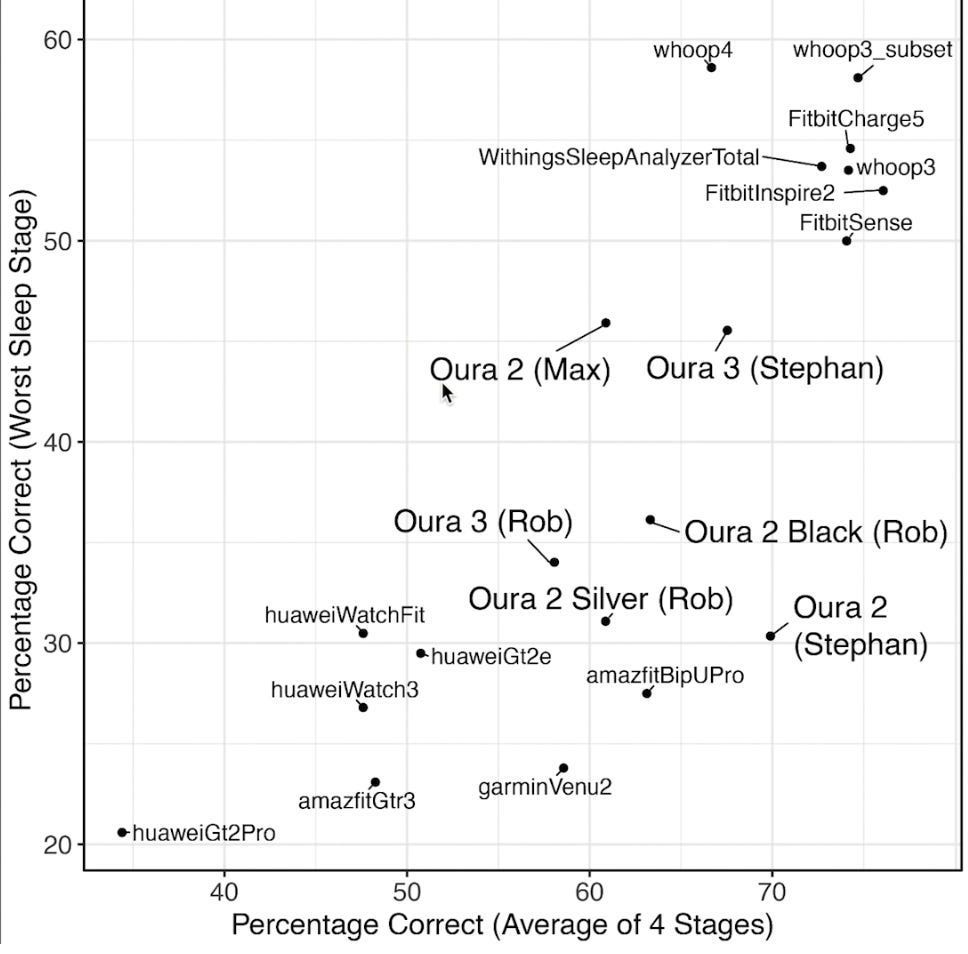
Now let’s talk about sleep trackers. Some people I know have claimed to have gotten interesting insights from sleep trackers. However, these devices are not very accurate, and improper “insights” from noise in the data are common.
In 2017 researchers coined a term called orthosomnia to describe a new class of people who have an unhealthy obsession with optimizing their sleep tracker score. Orthosomniacs may struggle with anxiety, stress, and daytime fatigue all caused by their sleep score obsession. Their daytime fatigue may be due to stress, a simple nocebo, or poor sleep caused by the mechanisms I’ve been discussing in this article.
A new lawsuit against Oura accuses Oura of misrepresenting “faulty AI-based inference as reliable science” and of “taking advantage of desperate consumers who struggle with their sleep”.
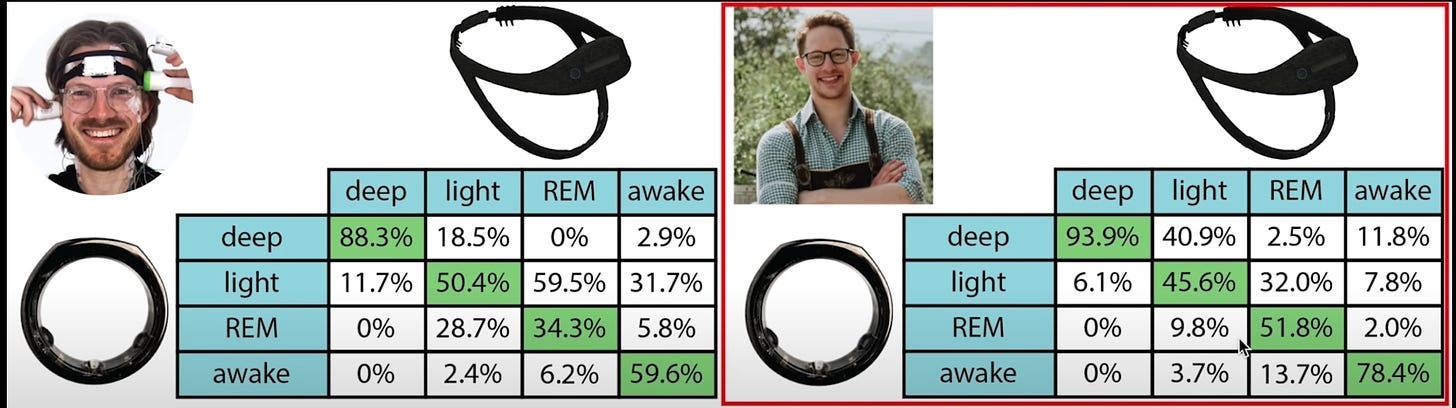
Studies show that commercial sleep trackers are only 30-70% accurate at classifying sleep stages. That means sleep trackers can easily show you not getting enough REM or deep sleep, causing stress and anxiety.
Commercial sleep trackers also have trouble identifying when sleep starts and when it ends. I’ve tried eight different devices and in my experience they all have an error of 30 minutes to an hour when measuring total sleep time.1
My guess is that the machine learning models that sleep trackers use are largely calibrated on normal people. Therefore, my guess is that the sleep stage predictions are less accurate for people who are taking medications that shift sleep architecture (like trazodone, benzos, some SSRIs) or people with sleep disorders like sleep apnea, restless legs syndrome (RLS), or periodic limb movement disorder (PLMD).
PLMD causes limbs (usually the legs) to jerk at regular intervals (20–30 seconds) during sleep. These movements are seen in 30-40% of sleep studies. Doctors debate whether PLMD is over- or under- diagnosed. Night-time limb movements are common across mammals — you may have seen a dog’s legs jerking every 30 seconds or so while they sleep. Periodic limb movements only become an issue if they become intense enough to bump a person out of deep sleep or wake them up in the middle of the night.
I personally suspect some sleep trackers may misinterpret limb movements as a sign of light sleep even if the person is in deep sleep. This guess of mine is informed by my own experience with PLMD. Trackers I used would sometimes show me awake or in light sleep for the first few hours of sleep, or report I got zero deep sleep even though I subjectively felt like I had slept OK in the morning.
At the end of the day, the only way to get accurate sleep staging is by monitoring the brain directly through EEG.
The best measure of how good your sleep was is how you feel in the morning. It’s worth asking - is advanced sleep tracking giving me much benefit over a simple 0-10 scale of how I feel in the morning?
Why I don’t recommend the Eight Sleep
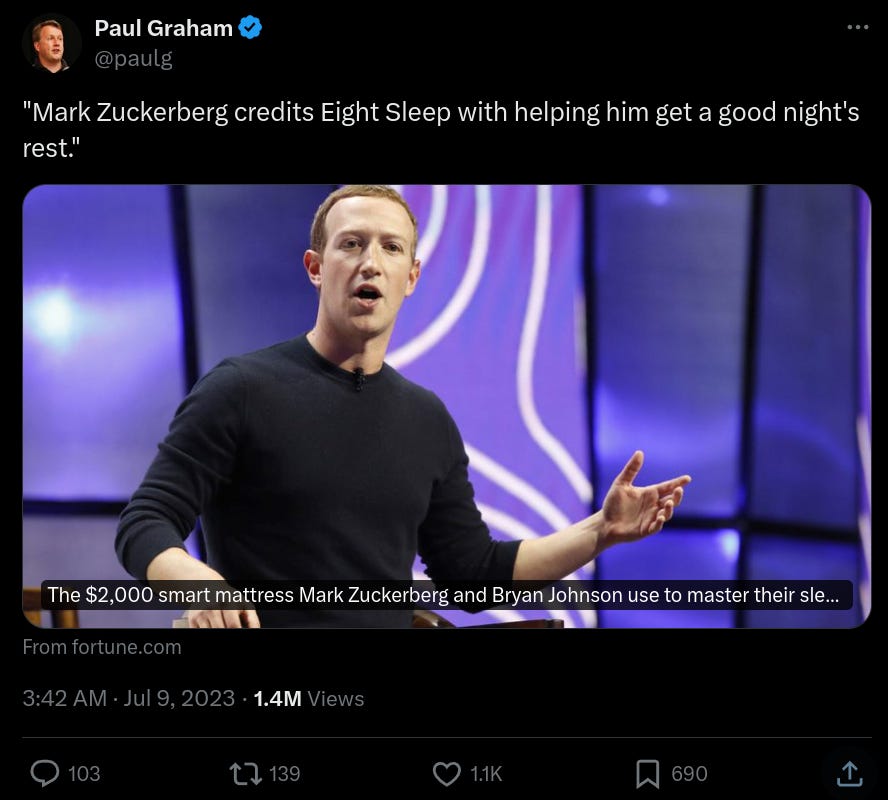
I want to briefly discuss the Eight Sleep and why I don’t recommend it. For those who don’t know, this is a water-cooled mattress cover that has become popular among techies. There are no good studies showing the device is helpful, but many prominent silicon valley tech people have raved about it on Twitter.2
When I was hit with severe post-COVID insomnia in 2022, I bought the Eight Sleep. It made my sleep worse. Even on the lowest setting, I found it was too cold. I struggled to adjust to the coolness, and eventually sold the system. I also found it stressful, as someone with insomnia, trying to figure out how to configure all the settings (you can configure multiple temperature settings during the night).3 More recently I tried a cheaper system (the Adamson B10) and ran into the same problem of it being too cold.
The fact that I was an Eight Sleep non-responder likely comes down to my own sensory sensitivity. But I also wonder how many other people there are who have had the same issue I had. I know one other person who told me they can’t use their Eight Sleep in the winter because it’s too cold.
In any case, the main reason I don’t recommend the Eight Sleep is that it is utterly unnecessary.
If you have trouble with waking up and feeling too hot in the middle of the night there is a simple solution - invest in a good AC unit, or turn down your heat!
The human body is already very good at sleep thermoregulation. If the body becomes too hot during sleep, you will automatically take your hands out from under your covers. The palms of your hands are particularly good at dissipating heat. According to Matthew Walker, your body naturally increases blood flow to your extremities as needed during sleep to keep you cool.
The best setup, according to Andrew Huberman, is to have a very cold room (ie 64-66 F) and several layers of blankets. Your body will heat up during the night, but you’ll naturally take your hands out from under the covers to cool down as needed. Your head may feel cold, but that is a good thing. In my personal experience, Huberman is right on the money. I cool my room to 64 degrees and use a weighted blanket with a comforter and two covers on top. The worst-case scenario is I wake up too hot and remove one cover.
I acknowledge there is some irony here in that I just gave a bunch of sleep optimization tips in an article warning about the dangers of sleep optimization tips. However, I consider this basic hygiene stuff, and all the caveats I discussed above apply. I mention these things as simple and effective alternatives to the Eight Sleep for those who suffer from being “hot sleepers”.
Further reading
Subscribe to my YouTube channel!
Personally, I have tested the Withings Sleep mat, EightSleep’s tracker, the Fitbit watch, Garmin Vivosmart 3 and 4 watches, the Oura ring (which I returned), the Whoop strap (also returned), and the Biostrap (which I couldn’t get to work). Today, I use the Withings Sleep mat to track my sleep, but with care.
There’s a particular gripe with Eight Sleep’s marketing materials I want to vent about, but it’s not that important, so I’ll do it here in a footnote. Eight Sleep markets their device as automatically monitoring your body temperature to keep it in an optimal range (when autopilot is on). That sounds great, but it turns out the device doesn’t actually monitor body temperature at all. The device has thermometers that measure the temperature of the air in the room and the water flowing through your device, but it doesn’t measure your body temperature directly.
There are three temperature controls on the Eight Sleep - “Now”, “Night”, and “Dawn” and a fourth option called “autopilot”. People on Reddit debate how to set these controls and whether or not to trust their sleep to the autopilot. Going to sleep should not be so complicated!
Great post. I wish more people would recognize that getting just okay sleep is basically fine for you. The act of stressing out or being mad about your sleep quality is probably doing more harm than good. Of course, this doesn't apply to people with OSA or severe insomnia. But there's a large contingent of people worrying about their sleep that are doing just fine!
Quite the analysis & report… 💯